Capstone #4: Digital Ethnography

There’s a group for everything, and some groups are larger than you might think. FIRST Robotics Competition, the grades 9-12 sector of FIRST (For Inspiration and Recognition of Science and Technology), is only one of four divisions. The numbers? Almost 100,000 students, 3,800 teams, close to 30,000 mentors, 33 countries. Across all four programs? 615,000 students, 72,000 teams, 250,000 mentors, and over 100 countries worldwide. If you’re looking for impact — these are our future leaders in STEM and innovation — robotics has it.

Let’s go back to the beginning, though. What is FIRST Robotics? It’s not BattleBots, that’s for sure. No robots looking to destroy each other, even if one does catch on fire every once in a while. According to the official FIRST website, “The mission of FIRST® is to inspire young people to be science and technology leaders and innovators, by engaging them in exciting mentor-based programs that build science, engineering, and technology skills, that inspire innovation, and that foster well-rounded life capabilities including self-confidence, communication, and leadership.”

“It may very well have hydraulic arms, a drive train, and a circuit board, but this isn’t a robot. This is a lesson in humility, hard work, and collaboration.” (0:11)

People that are in the robotics community aren’t just student or mentors, either (though most fill one or both of those capacities). I’d say that the people who fit this community are those who believe in the mission of FIRST and believe in its ability to be a “rock to shatter a thousand glass ceilings, a rope to pull a generation up and out of poverty, and a hammer to break down cultural barriers.” Though the community is primarily made up of those passionate about STEM, there are also plenty of people who are involved in teach and/or learning about the business/marketing sides of the program and other small niches that still need to be filled.

Where and when do these people congregate? Pretty much everywhere and whenever you can think of. Given that this organization is run and maintained by some of the most technologically-savvy people on the globe, there are groups dedicated to the discussion of FIRST in every channel you can think of. Just like any other large group, there are also groups inside of FIRST that also meet and chat, like the girls of FIRST, LGBTQ+ of FIRST, and of course individual teams and regions.

The way that FIRST operates lends itself to meeting in-person at specific times of year. Each year, FIRST will release a “game” for each program (for FRC, the game is released at the new year, for FTC, in the early fall). There’s a difference game each year to ensure no team has a distinct advantage over another and to continuously challenge team members. After the game is released, teams have approximately two months to design, build, program, and wire a robot before competition season starts. During competition season, which goes for about 6-7 weeks (in Nov-Dec for FTC and in March-April for FRC), teams will compete in an average of 3 competitions (the exact number varies per region and how far a team advances).

Team members on the same team very well may see each other every day during the “build” season (my team meets every weekday except Fridays from 6-10 pm and from 8 am – 4 pm on Saturdays), but all season long students and mentors will converse with other teams across the globe about strategy and design. Chief Delphi, a forum created for FIRST by the team of the same name, serves as a meet-up for many mentors, though it has recently become less popular in favor of online spaces like Facebook and Discord.

For a competitive team, it seems a little odd that the teams will share resources and advice, doesn’t it? Well, FIRST heavily encourages Gracious Professionalism, a term that was coined by Dr. Woodie Flowers of MIT. Gracious Professionalism is “a way of doing things that encourages high-quality work, emphasizes the value of others, and respects individuals and the community.” This notion is also helped along by the fact that no robot competes with another robot one-on-one. The games are designed as 3-on-3 (from 1999 onward; teams did compete individually from 1994-1998), and competitions are split into two parts: qualification matches and elimination matches.

Teams will compete in 12 qualification matches with randomized alliances to determine their ranking. A team that you might play against one match may be your alliance partner in the next, so teams generally are very happy to help one another. At a competition I went to a few years ago, a team went around offering code to every single team there that would get the robot to cross the HAB line in autonomous (that gets your alliance a certain number of points). Plenty of other teams will even post their entire robot code to Stack Overflow or GitHub for their robotics peers to look at, suggest improvements, or even copy for their own respective robots.

After the qualification matches are over, the top 8 teams in qualification rankings will become the alliance captains, who will choose their alliance partners for the duration of eliminations.

Rules of alliance selection: 4:41 to 6:14

Even when alliances have been determined, teams don’t stop being supportive of non-alliance partners. Every alliance captain is given two coupons for use during eliminations: one for a six-minute timeout and one to call in a backup robot (only used if a robot is broken and can’t be fixed within a reasonable time limit). If another alliance needs extra time, it’s not unheard of nor uncommon for an alliance to offer their timeout coupon toward the alliance in need, even though it aids an opponent and puts their own at a disadvantage in the event they might need the timeout themselves.

FIRST, which was founded by Dean Kamen (the inventor of the Segway), probably looks a little nuts from the outside. Though modeled after sports, robotics members have often been overlooked or even criticized by sports team members. On my team, members gain an activity letter (note that it’s not a varsity sports letter) after their sophomore season, and those who wear their letters on varsity jackets have come under fire from writers of the school newspaper for “not working for them.” Very rarely are robotics teams given the same respect as sports teams, and even more rarely are they commended for the thousands of hours robotics teams put into community service and outreach.

Despite not gaining a lot of traction in most local communities, FIRST teams do a lot of good, and sometimes it’s noticed. Recently, a viral video was released of a robotics team building a motorized wheelchair for a child in need whose family could not afford to buy one, and the team has gotten a lot of attention for it. As great as it is that the team’s accomplishments have spread, feats of this nature aren’t new to FIRST. All the way back in 2014 (I feel old saying that), I talked to a team from Israel (yes, Israel) at the World Championships who built a stop-and-go car for children who are blind. These are only two instances of the potential FIRST teams have to offer their communities.

This community would simply not exist without the digital. First and foremost, robotics is founded on technology and relies on some of the most up-and-coming technology to continue operation. Perhaps in the early, early years of FIRST teams didn’t use the digital to communicate with each other, but FIRST has thrived on the concept that no team is an island from the beginning. FIRST has grown into such a lasting and supportive community because of the outreach of teams.

The winner of the most prestigious award FIRST has to offer, the Chairman’s Award, was FRC 3132 Thunder Down Under in 2017 at the Houston World Championship.

As the video outlines, 3132 is so successful because they are inspired by and they inspire teams across the globe. None of that would happen without digital communication and support.

Final

For this thingy — I wouldn’t really count this as a project, necessarily — I’m supposed to “find something cool, interesting, whatever and tie it into one of our main ideas.” Presumably, this means online, but screw that. I want to talk about robotics (partially because that’s what I’ve been doing with single-minded focus over the last weekend).

For those of you who know me, I’ve been involved with robotics since high school. Over the course of the 9-week competition season over March and April (we just completed week 7), I’ve spent approximately 120 hours volunteering at competitions over four weekends. Right now, robotics is my world, especially because the 2019 World Championship will be held in just a week and a half at the Cobo Center and Ford Field in Detroit (those of you in Fan Cultures during spring term, I’ll be looking and feeling like death for the first few days of term).

Anyway, that was *sort of* off-topic. Let’s go back to class material and how robotics might tie into it.

The reality is that the internet is physical. It’s a public forum. It’s “a park, a playground, an airport terminal, a polling place, and a town square.” It’s a party. A social network. A construction site. If it’s all of these things, which one is it? The truth? The internet is all of these things at once, at the same time, and everything in between. We’ve largely spent this class discussing all the different facets of the internet, ranging from the beginning “Internet of Things,” to memes and their role, the internet as an almost-infinite database, how things go viral, media & fake news, internet & bots, social media and relationships, the internet as a mausoleum, and how groups interact with each other online. However, the internet isn’t really each of these things separately. When we discussed social media and relationships, millions of posts were going up on social media accounts worldwide. Thousands of those posts were memes. Hundreds more were news (possibly fake news). Tons of those posts were by bots. At the same time that social media was spreading viral trends, millions of people were just accessing the internet to perform a Google search. To look something up on Wikipedia while implementing that knowledge into a discussion group on Discord. All of these things are constantly interconnected, which is why this class is so sprawling with across-the-board ideas.

I just spent three days (and somehow, those words don’t seem to properly encapsulate how much time and energy I put into robotics this weekend) surrounded by robotics. Robotics, and by extension science and technology, is just one community that displays all of the characteristics of the internet I just listed off.

The task for this year’s game, Destination: Deep Space, presented by the Boeing Company.

Robots are a perfect example of The Internet of Things & the physicality of the internet. When FIRST Robotics Competition first began in 1992, four robots, each connected to the driver’s station via a cable, competed against each other on a 16-16 ft plywood field covered in approximately 2 inches of corn (think unpopped popcorn kernels). Over 20 years later, we’ve ditched the physical cable in favor of connecting over wifi. It’s easy to forget that the robots aren’t just acting on their own sometimes, but that thought is easily remedied whenever a robot disconnects from the field (comms issues are relatively common, in part from whenever someone creates a *forbidden* wifi hotspot).

At 1:07, you can see my team’s robot (862, blue bumpers on the lower left-hand side of the screen) temporarily disconnecting from the field (noted by when the green light flickers off).

As you can see, even massive robots are subject to the whimsical nature of reception. The physicality of the internet isn’t just about wires and wireless, though. It’s also how everything runs together. On my team, there are four mechanical subgroups: fabrication, design, electrical, and programming. Not one of those groups could produce a functioning robot on their own. Without design, fabrication wouldn’t know what to build and even the best code in the world wouldn’t work without wires to transmit the commands. For instance, in the first fifteen seconds of each match, a lot of robots (attempt) to move according to pre-programmed (autonomous) instructions (although this year, that’s a little unnecessary with the added feature of using vision).

The first fifteen seconds of each two-and-a-half minute match operate on solely autonomous programming.

In robotics, no team is an island, similar to how no subgroup can be successful on their own. Due to the nature of competing on alliances of 3 teams as opposed to a more traditional one-on-one like sports, teams are heavily encouraged to help each other in any way possible. In fact, earlier this season, I volunteered at a competition where a team helped build a robot from scratch for another team, and at the same competition, another two teams offered team members as drivers for a team who only had a coach show up. It’s not just at competitions, either; FIRST is a huge global network, and has numerous social media groups where team members, mentors, coaches, and volunteers share everything from cries for help to the newest scientific breakthrough.

Facebook is only one medium FIRST members use to connect with one another.

Looking to find information, just as Steven Reddy was? Look no further than one of the biggest robotics forums, Chief Delphi; the official FIRST website for information on starting teams; or The Blue Alliance for any team information/insights. If none of those suit your tastes, go a little more modern and join one of the several Discord servers.

Those channels, especially Discord, aren’t just treasure troves of resources. They’re also where members of the FIRST community congregate to chat, organize t-shirt trades (#black-market), share stories, and post memes.

Important intellectual discourse happening here.

Notice here the “stuplime” nature of robotics — just a click away are lots of threads for every technical and non-technical discipline in robotics. In the match video from ESPN below, there’s even a monkey dance line moving around the arena while waiting for the results (a tie).

9:28, monkey dancing. The defining moment of the 2019 FIM State Championship.

There’s plenty more that I could talk about how robotics present almost every aspect of the internet we’ve discussed in this class, but I’m just now realizing that this was only supposed to be 2-3 paragraphs (oops), so I’ll stop here. Feel free to chat with me more about robotics if you want me to talk your ear off about it. 🙂

My team (Lightning Robotics) won the 2019 State Championship alongside the Gems (4362, Brighton) and the Goon Squad (3604, Woodhaven) out of 160 teams at the championship and 542 teams statewide.

Capstone #3: Digital Footprint

I’ll be honest here, I’m not entirely sure how to go about this. So I guess I’ll just start and then see where it goes, huh? This is a judgement-free zone, right? (I can feel the judgmental stares through the screen right now.)

Social media and I have kind of a weird relationship. I’ve usually been a bit behind the curve of popular trends amongst my age group — I’m typically too buried under the covers with a book or too busy running around to robotics to care. I often browse through social media to see what other people are up to, but I can’t say I personally am that active.

I only have one social media account (or really only one that matters, I don’t use Facebook almost at all outside messaging services and academic groups and only got an account for that purpose), which is on Instagram. @potassium1939.1. I’d link it, but it wouldn’t do much good because I have my privacy settings on. Fun fact: that username is my handle on pretty much everything because it’s kind of an inside joke. In middle school, two of my friends and I all were learning the periodic table and we all were science nerds at the time (that was before it actually got hard [says the biology minor]), so we all gave each other element nicknames correlating to our names via the symbols. Potassium’s symbol is K, and its atomic number (number of protons in the nucleus) is 19, and its atomic mass is 39.098 (rounded to 39.1), hence, potassium1939.1 actually all boils down to “K.” Kind of cool, right? Okay, maybe I’m the only one who thinks it’s fun. Whatever. *insert huffing face emoji here* Conveniently, the username is almost never taken! Wonder why it isn’t more popular.

Well. I suppose we ought to start at the beginning, right? And usually that means looking at the profile.

I posted how much?!

It’s a little scary, actually. I was initially going to look at the profile picture and bio, I’m going to point out the fact that as of March 24th, I’ve posted a staggering 742 times. Even if you limit that to one post a day, that’s a post every single day for two years (and twelve days, not counting an extra day for a leap year). Two years is a tenth of my life (that made me feel both very old and very young). I’ve had an Instagram account since midway through 8th grade, when I got it for church youth group communication purposes, so I’ve had one for approximately 6 years. Even so, 742 posts across 6 years comes down to about one post every 3 and a half days (I think I calculated that right; disclaimer: not a math major). That’s crazy. Even though I don’t post regularly like that — I usually post two or three pictures in a row and then not post again for a week or two — that’s still a lot. And I tend to think of myself as relatively unattached to social media!

Anyway. Back to my profile. It’s true that everything about my profile is very carefully cultivated, partially because anyone can access my profile. My goal with my profile was to leave enough information that the people who know me can find me, but leave out enough that random people looking to stalk young girls didn’t know who I was. The result? A picture that’s clearly me, but with sunglasses I could be anyone if you didn’t already know me.

So that’s the profile picture. Let’s more on to more interesting things, shall we? The bio! PHS ’17, Plymouth High School class of 2017, but so many places start with a P (Pioneer High School, for example. A school not even 30 minutes from my own.) that without knowing me, would be difficult to distinguish. Obviously “Alma” is hard to misinterpret, but there’s a ton of people who both go to Alma and are associated with Alma. After that, you get to the part of my profile where I guess I try to be cool and hip and unique and whatever it is that people try to achieve in 160 characters or less (or whatever the roof limit is on that). I’ve had more or less the same bio since 11th grade, and pretty much the only changes have been to some of the emojis I used in it. Again, part of the point was to make it obvious who I was to anyone who would know me, but unclear enough to interest strangers.

Anyway, in case it wasn’t completely obvious, the chosen emojis are supposed to represent things I like or do, funneled into a math equation: I love pandas, I love to read, I enjoy painting, I play a lot of Pokémon (GO and otherwise), my personality is obviously fabulous, I write digitally (hello, journalism!), I ride a scooter around, I’m Chinese, religious (though not obsessively so), I’m from Lightning Robotics (the year after we won the world championship I had a globe and a trophy next to it as well), and I like music (there isn’t a flute emoji, unfortunately). To end everything, I add a dash of my sparkling personality and poke fun at my oddness and other people’s potential inability to understand my weirdness.

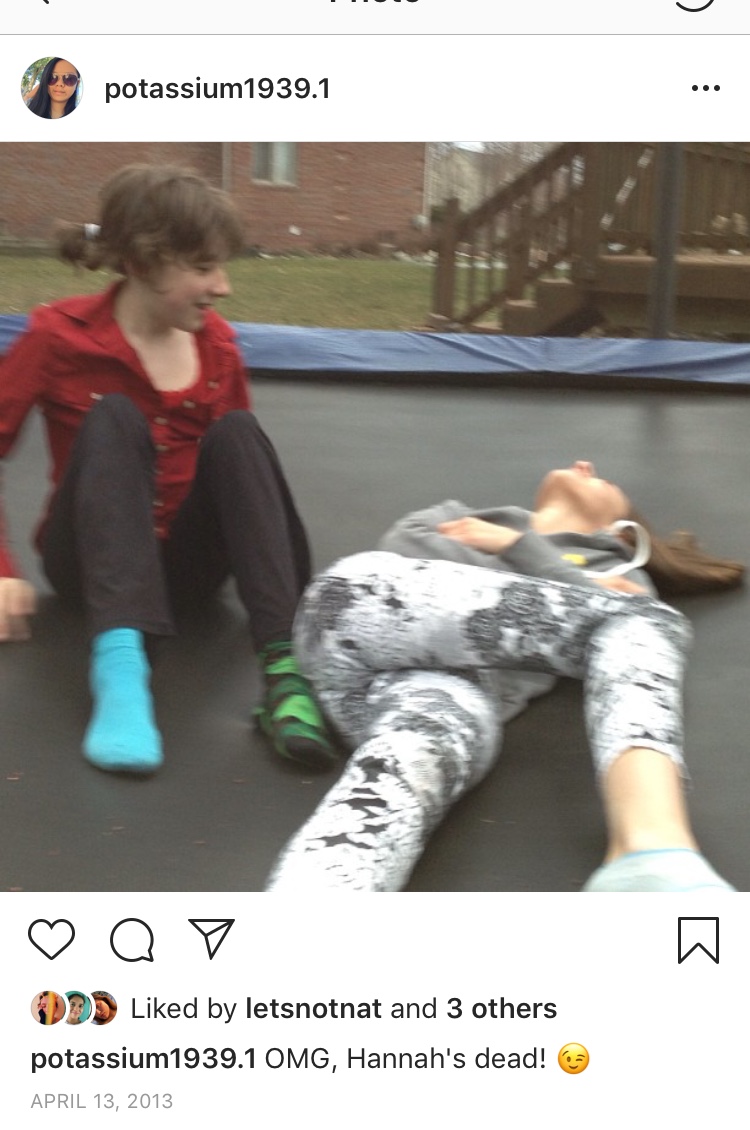
OMG, this post was so bad!

On to my first social media post ever! (Not sure the exclamation point was necessary.) I think this was taken on a trampoline, which explains why the photo is so shaky…doesn’t excuse the fact that I posted it, though. I was in 8th grade when this was posted, and I’d like to think my vocabulary has since expanded for captions beyond “OMG.” -.-

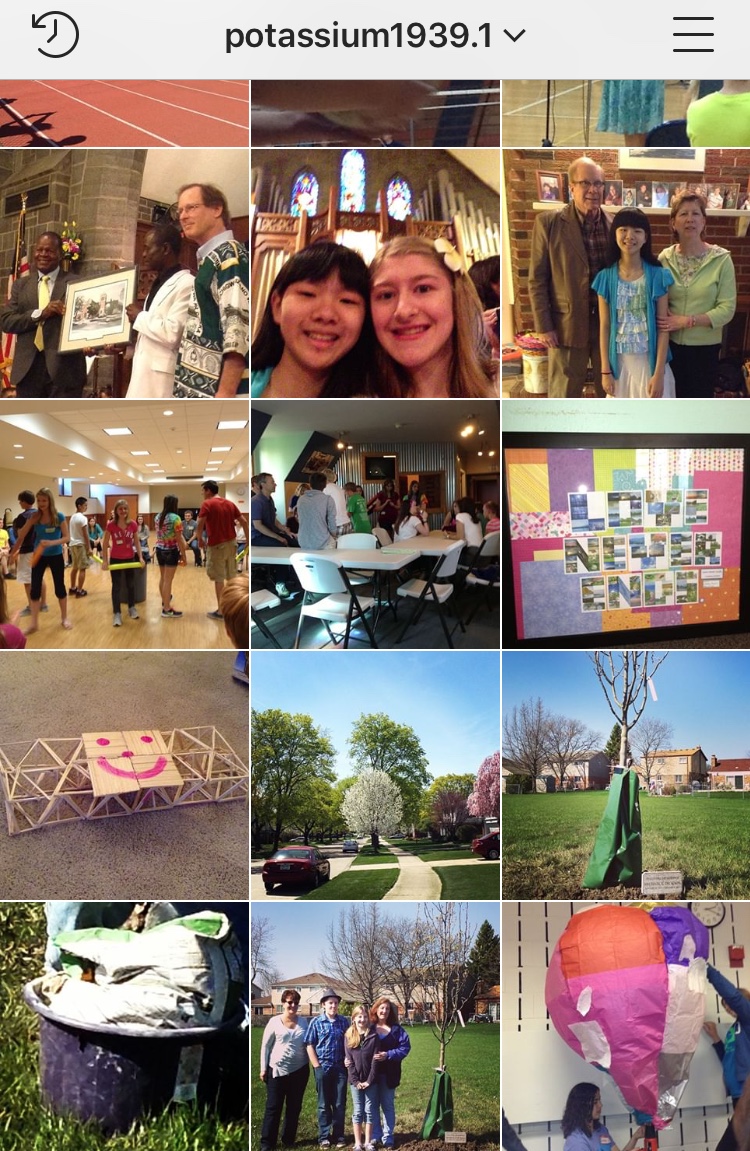
My next several posts were equally juvenile:

I’m currently trying to figure out why the heck I posted a picture of a bag of cement…

I’m pretty sure that these were more experiments in filters than anything else…I can place some of these but not all of them (that balloon is made of paper, thank you very much). Nothing super exciting here except for pictures of me back when I had bangs (oof).

Most of these photos were posted on the same day.

Still early into my Instagram foray, I found out here that posting a bunch of photos at once definitely do NOT garner the “likes.” All of these photos were from a mission trip I went on to West Hollywood, CA (and I think the total number of likes to these 8 was around 30, and probably the majority of those were the same two people liking all of them). Do note that by this point, I’d mostly figured out that a.) posting photos of people is exponentially more interesting than a stupid bag of cement; b.) smiles > non smile (sometimes a funny/stupid face is an exception); and c.) I didn’t really care for filters.

Fast-forward to my freshman year of college.

For the most part, after holding an instagram account for several years, I think for the most part mine is a relatively solid slice of my personality — definitely a sunnier side of me than maybe I am most of the time (and a lot less of me looking like a slob), but I wouldn’t say that I’m hiding anything behind #basic posts the way that a lot of my friends do on their “rinsta” but display on their “finsta.”

My account is a pretty accurate reflection of what I like to do.

I’d say that my personality on my social media is also reflective of my interests: a lot of robotics (robotics posts tend to dominate my posts from March-April, as that’s competition season), some school things, a religious post (Happy Easter), a post from a percussion ensemble concert…nothing incredibly surprising or shocking here.

Do I post a lot of smiling selfies? Yeah. But honestly? I wouldn’t say that’s really dishonest, either. I guess I like it when I get plenty of likes, but at the same time, I also know that posting robotics photos don’t generate a lot but I still do it because I like robotics and my likes and dislikes should rule my own damn account, thank you very much, please pardon my language.

I’ve always held the opinion that my social media is a chance for my friends to keep up on me and what I’m doing. Not to throw shade at anybody else, but I don’t really understand when you post something solely for likes. Maybe I’m more aware of the “like” culture than I was when I started my account, but I don’t post things for the sole reason of getting likes. My life is my life, you know? It’s ruled by me, not by faceless followers who somehow rule my life by mindlessly not “liking” every single photo. My self-worth isn’t about my social media, it’s how I feel about myself, and how other people I may or may not know well can’t change that.

Journal #6

Do I spend a lot of time on the internet? Yes, yes I do.

How much time do I spend on the internet and what do I spend that time doing? That’s a loaded question. I spend the most time playing games (although the time my phone says I was playing Bit Heroes I wasn’t actively playing it; it has an autoplay feature that I use to farm items and XP when I’m working) or checking email; this past weekend, I spent a lot of time checking thebluealliance.com for updates on other robotics competitions (FRC competition season started!). I spend a lot of time on my phone reading books that I either pirated off the internet or got from KindleUnlimited. I scroll through social media a fair amount, I’m not really sure how much I actively pay attention to what it is I’m looking at, though. I don’t know, I’m not a very exciting internet user. I don’t really watch a lot of youtube videos (except for the occasional music video or SNL skit) and I don’t really surf the web to surf the web. I’m not super updated on the latest pop culture or nerd culture or really any kind of culture (maybe book culture). I wouldn’t say I’m obsessed over social media. I’d probably label myself as an internet bystander, to be completely honest.

Capstone #2: Rhetorical Analysis

Buzzfeed. I wonder what asinine thing I’ll obviously be clicking on today.

I think the most famous thing about Buzzfeed is its knack for striking just the right balance between quippy and straight-up clickbait-y headlines that lure casual social media scrollers into reading an article about trendy foods to eat that’ll help you lose weight and then somehow into taking a quiz to figure out whether Buzzfeed’s algorithm can accurately guess which astrological sign you are based on your favorite food. Everything about Buzzfeed — from its Headlines That Are All Capitalized to content that is just wacky enough to interest reader — is carefully crafted to attract internet users to its website.

Regardless of how low an esteem some might hold Buzzfeed (“it’s just another Buzzfeed quiz,” etc.), Buzzfeed’s team of marketing experts certainly aren’t playing around. It’s no accident that Buzzfeed has earned the reputation that it has for cute and fun 5-minute reads or quizzes with “results that will shock you!” With a finger constantly on the pulse of what’s hip and happenin’ and a good sense of when to post fun things that are a #tb to young people beyond early teens, Buzzfeed knows exactly what will make you stop and click, not just what might.

Buzzfeed’s logo — its branding — is all about the bold to lure a reader’s wandering eye. Its choice of red, pink, and orange main colors are eye-catching, especially in the digital realm, where most color schemes are modern and cutting-edge blocks of black and white and blue hyperlinks. Its “up” zigzag symbol is reminiscent of the “share” social media function (with the arrow) and the upward direction seems to indicate to readers that Buzzfeed is definitely on top of the game. Everything about Buzzfeed’s visual marketing is to scream out to your eyes, “Look at me! I’m here!”

It’s not just about the content and how it looks, either, though that’s arguably the most important part. The way Buzzfeed chooses to phrase its headlines and how their photos are chosen all look and sound like something that might actually be said within the “young people” culture and not anything like your mom trying to be cool by using the lingo at inopportune moments. Weaving a balance between “wtf” and informative/entertaining writing might be a challenge to some, but the way that Buzzfeed does it makes it more like you’re chatting with a friend.

Even though its website maybe isn’t the easiest to navigate upfront, it’s also not designed to be. Possibly one of the media organizations most in tune with the younger generations, Buzzfeed relies almost entirely on social media to spread its content. Sponsored ads show up on your feed, and friends who’ve taken them already want to know your quiz results against their own. And when you do cave and click on it, there’s a helpful little sidebar telling you what’s trending and suggestions of what to look at next. Buzzfeed’s website is designed to be navigated page-by-page, not all from the home page, unlike pretty much every other site out there. And in Buzzfeed’s case, that’s a strength and not a weakness. Pretty much nobody (with the exception of maybe a grandma whose grandchild told them to check out Buzzfeed) goes out to buzzfeed.com just to click around. Everybody enters Buzzfeed’s website for a specific reason, and most likely entered through a specific page link. In the end, it doesn’t really matter how haphazard and neon-light flashing sign the homepage looks, because no one actually goes to Buzzfeed to look at the homepage.

Word-of-mouth (or more accurately, word-of-post) is crucial to Buzzfeed. Without people constantly sharing and spreading Buzzfeed’s content, their entire system goes down. As a result, everything on their website is made to be shared across social media platforms. Quiz results pop up in a box that offers instant-click options to share to Twitter and Facebook — and it’s not just a simple link share, either. The message embedded in the post, “I got ___!” encourages your friends to take it as well to find out what they got in comparison to you.

Quizzes, while quite possibly the most famous thing about Buzzfeed, are only the tip of the iceberg of Buzzfeed’s content. Even with Buzzfeed’s sweeping layoffs to its newsstand reporters only a few weeks ago, it still retains a news section that boasts news in a way that doesn’t force the younger generation to feel like they have to be previously informed to read. Buzzfeed’s reputation as a fun and flighty content producer helps it reach out to those of us who want to know what’s going on but are a little too uninformed to feel comfortable running off to big news conglomerate sites that have been running articles on the very topic for ages and are tossing around tons of information you don’t even have the slightest clue about despite them telling you it happened 3 months ago.

The entire point of rhetorical strategy is to use various appeals to (hopefully) successfully create an argument that will achieve your goals. Buzzfeed’s goal? Attracting readers who are simply wandering around on social media into their land of knowledge, gossip, and fun content. They accomplish that by utilizing everything in their disposal, from flashy graphics and photos to using the reader themselves as more advertising. The intentional design around luring the younger generation (probably one of the tougher ones to get at, with constantly changing interests and expectations, along with a very limited testing group of people old enough to have legal autonomy) creates a fun and, in a sense, stupid environment where you don’t have to feel ashamed for wanting to know what fruit you are based on how messy your room is. And while you’re at it, you might as well look at the news that you’re actually interested in reading on a platform not quite as intimidating as time.com with all of its worldly articles.

Journal #4

(Fun fact: I typed “$4” instead of “#4” accidentally before I fixed it…yes, that will be $4 to view this post, please.)

Goldsmith’s idea that we’re not really wasting time when we’re wasting time is actually rather appealing to me. Honestly, I’ve never been to sure whether I should really be putting much stock into those “Warning: Danger!” signs that people always seem to be advertising about the dangers of the internet (that, ironically, are posted on the internet). In my opinion, most people my age know what to avoid clicking on (I’m not interested in single Russian females in my area, thank you very much) and what is appropriate to share publicly (most people my age don’t post videos of themselves randomly insulting someone’s mom (I made that up, but it’s true that no one really does that because that’s really insulting)). However, I’d also say that Goldsmith is really, really, really, open-minded about it in ways that I’m not, and I’ve more or less grown up under the influence of social media and the internet, even if I wasn’t really part of it until high school. His idea that we’re never wasting time when we’re exploring the net is kind of absurd, if you ask me. I waste my time on it all the time when I’m trying to get things done — In the last hour alone, I’ve paused writing this journal entry to stop and check up on my farm game that everyone guilty-plays or check my email. The internet has absolutely changed our mindset about how we focus; in the past, it was relatively easy to be focused because our friends weren’t just a touch away — we had to either leave the house or call them over the landline, both things that give you time to pause and really evaluate if that’s truly what you should be doing right then and there. Even though I agree with Goldsmith that the internet isn’t necessarily a bad thing (the medium is changing of how we communicate, not necessarily the message itself), I think Goldsmith is a little too open about his ideas concerning what is and isn’t a concern.

Journal #3

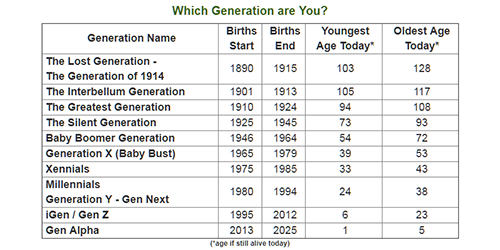
As with any generation, there are overlaps between that generation and the ones directly preceding and descending it. For the longest time, I thought I fell into the “Millennial” generation because I’d always heard it described as “people who lived during parts of both millennia” and I was born in 1998 (forget the fact that I don’t remember anything prior to roughly 2002). Actually, looking back, that seems like kind of a stupid assumption on my part, since there’s actually tons of people who have lived in both millennia; if my thought definition was true, that would mean that everyone 19 and older would be a millennial, and most people are not millennials. Anyway. That was kind of a really long tangent. Sorry about that. It’s hard for me to classify myself as “Generation Z,” though, even though that’s what I am .

According to this chart, I very solidly fall in Gen Z.

We read that article comparing millennials to Gen Z-ers (I don’t know how to phrase that??) and I could identify with both sides for a lot of characteristic traits — like I’m similar to millennials in that the majority of my childhood was not surrounded by technology (using computers was restricted to computer lab time in school and TV was something that I only watched on Saturday mornings when my favorite shows got new episodes) and I’m a believer in college education despite loans (obviously, as I’m in school), but as far as style and connectedness, I’m more of a Gen Z-er (I’m just going to call us that), because brands don’t particularly matter to me and I’m definitely pretty social-justice oriented.

I realize that I haven’t actually answered the journal prompt, but it was something I felt like saying and as my professor I’m pretty sure you have to read all of it. (And it’s not like I’ll ever find out if you don’t.)

ANYWAY. How I feel about being tied to the idea of “likes” is sort of complicated. I got involved in the social media game kind of late; most of my peers joined Facebook (2004) when it was still “cool” (which is to say from about 3rd and 4th grade to the beginning of middle school, which is when Twitter (2006) and Instagram (2010) became the dominant social media platforms). I joined instagram for the first time in late middle school, which was only because my church youth group was using instagram for communication about upcoming events and updates that I thought I really ought to know (my mom had previously offered to let me create a facebook account as long as she had my username and password; I turned her down because what burgeoning teenager wants their mom to have direct access to anything? >.<!), and then in high school I had snapchat for all of three days before I decided I hated it and deleted my account, and I joined facebook just this past fall when the newspaper essentially required me to create one. Even though my two social media accounts were created for the sole purpose of something else (church and the newspaper staff), it’s amazing and a little scary how much they’re part of my life now. I don’t really scroll through instagram that much, but I probably skim facebook once or twice every few hours, just to see what funny things my friends have posted about cats or pandas or Harry Potter or whatever. I don’t post myself very often, though.

When I was in high school, other than snapchat, having a “finsta” was the it thing to have — a finsta is an instagram account (the name is a portmanteau of “fake” and “insta”) that’s your “fake” account (meaning that it’s not your public identity account — we’d been scared by counselors that college admissions boards and employers looked at our social media presences to post our “real selves” out in the open) where you post stupid shit like memes and bad selfies and random thoughts without any fear of retribution from the all-seeing eye of high school society and hierarchy because the only people you let follow your finsta are your select friends, probably five to fifteen at most. I can’t say that it makes a lot of sense to me (the concept that your “rinsta” [real insta] was public and your finsta wasn’t even though they’re both on the internet and perfectly hackable is a little stupid), but the need for validation is absolutely real. My generation is so tied to the amount of likes we can get on our posts. I’m not immune to it either — I’m well-aware that the most-like post on my instagram is my prom photo — but it’s scary how much it matters to us. It matters so much that we felt a need to create a totally separate account where we could be “real” and our real accounts had our fake smiling selfies that the world could see because then it would look like we weren’t the disasters we really were.

Journal #2

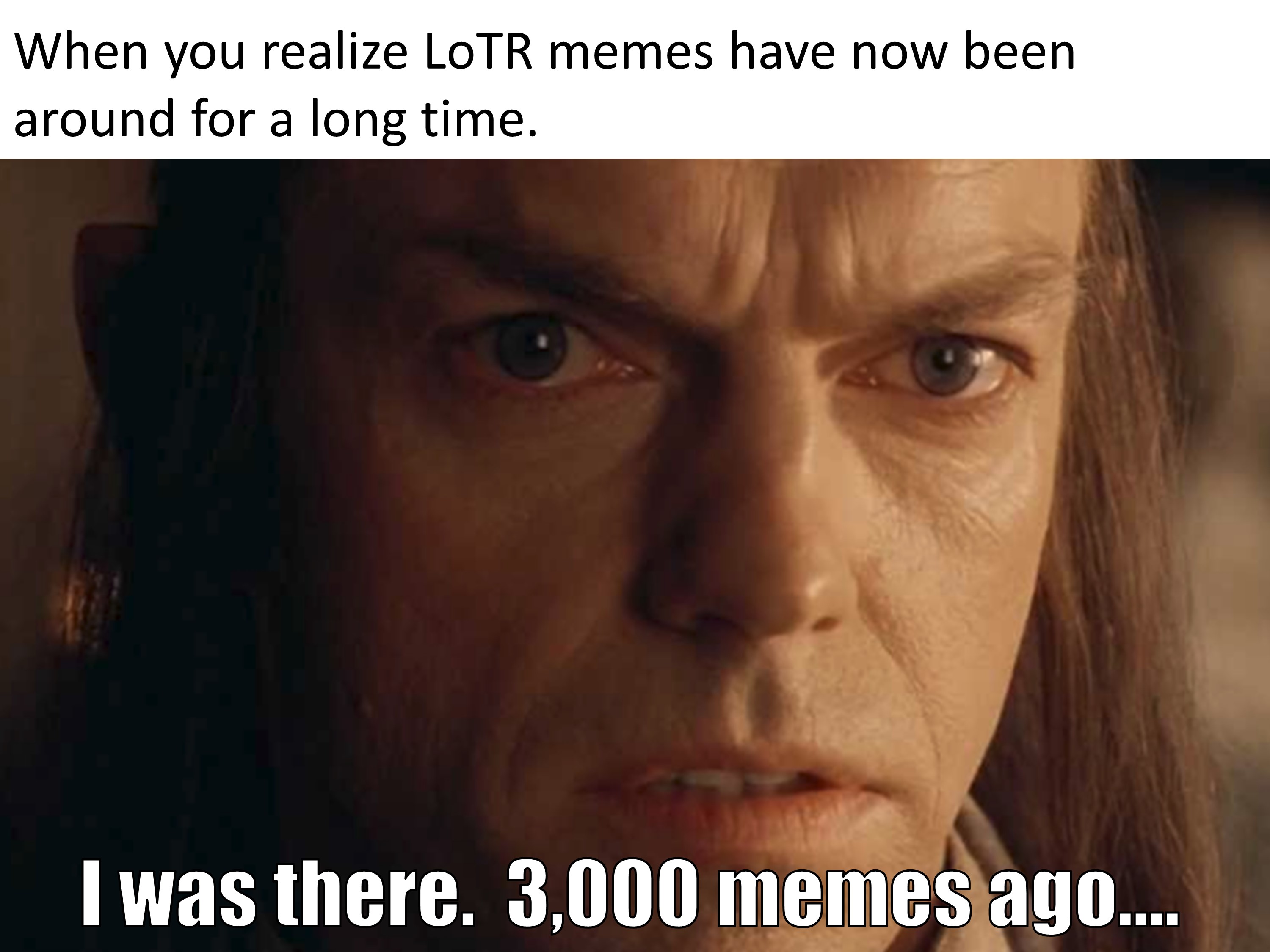
Image result for I was there 3000 memes ago
Wonderful. Now I have a meme.

In McLuhan’s The Medium is the Message, he essentially asserts that the way that we access information is just as important, if not more important, than the information itself. I technically found this particular meme by searching Google for “I was there 3000 years ago meme” (it was the first result that popped up under the “images” tab), but the more accurate answer is that my roommate found it and joked to me that when she takes digital rhetoric (she’s a writing minor) she’ll use this meme in her capstone meme project (assuming Cicci does this project every year). In keeping with how McLuhan views media, I guess this says something about how I find funny memes: through my friends, who find them through their friends, and so on and so forth. Most memes I see are on Facebook (I’m outdated and ancient, I know, I’m not even on twitter and frankly I hate Snapchat), and though most of them come from shares from other facebook pages not tied to a person they’re all shared to my feed from my friends (who probably shared them indirectly from the page anyway). According to McLuhan, this means that the more important factor here is that my relationship and communication with my friends and family matter more than the meme itself, which in this particular case, I’m inclined to agree with. It’s not necessarily that I care about this meme in particular (or about memes in general), or that I find it somewhat funny, the reason I picked out this meme to discuss for this journal has far less to do with the fact that it’s a funny meme and more to do with the fact that since she’s the one who shared it with me, it sticks in my head.

Journal #1

The best thing about the internet is that information is so readily available. If I want to know anything, odds are it’s floating around somewhere in the internet, and I can find it if I search hard enough. It’s really easy to acquire information this way, and as a whole, I’d like to think it keeps us as a society more informed and culturally aware. It’s also very convenient to have all of the information database that is the internet at our fingertips, literally. In older days, we had to go to the library and look up resources in the card catalog (dinosaur days, man), but now we can just open Google and type in a question. Bam, there’s the answer, plus a thousand or so other answers/opinions on other webpages.

On the other hand, I think the worst thing about the internet is kind of the same thing as the best thing. It’s a double-edged sword; sure, the idea of having easy access to all of that information to stay up-to-date on all that’s happening in the world is great, but how many people that really live and breathe the internet actually utilize the internet to that function? I don’t really think that many do, including me. In fact, even if I do Google “news,” my newsfeed is tailored by Google to pop up only the most relevant news its algorithm thinks I’ll be interested in enough to read, and even then I’ll probably skip over roughly 3/4 of it. Though it’s counterintuitive, the fact that the information is always “there” often becomes an excuse to not be informed because you don’t need to stay constantly informed if you can just look it up for when you actually will need to know it. Along with how easy it is to find these sources, it’s also then very easy to find not credible sources. When we used to go to the library to find sources for essays, all sources from the library were credible because published books go through a vetting process of being fact-checked and are selected for publication based on a number of factors. However, being published on the internet is extremely easy. Heck, the blog post I’m writing now will be published to the internet in just a few minutes, and how do you know if I’m credible? The answer? You don’t. The fact of the matter is that having so much information available to us all the time has, in a certain sense, made us lazy, but at the same time, has given us an incredible resource. Whether the ideal of the internet ends up being the best thing or the worst thing is up to each user, I guess.